romantic=conducive to or characterized by the expression of love

rendezvous=a meeting at an agreed time or place

Have you ever had a romantic rendezvous? I’d love to hear about it. What made it special? Was it a first meeting, a meeting after an absence, a farewell?

Romantic fiction often talks about the “cute meet”—the moment when the two (or more) love interests meet for the first time. They might not know it, but the reader guesses pretty fast that there’s something between these people—curiosity, attraction, or blazing lust. It’s fun deciding how to introduce them to each other.

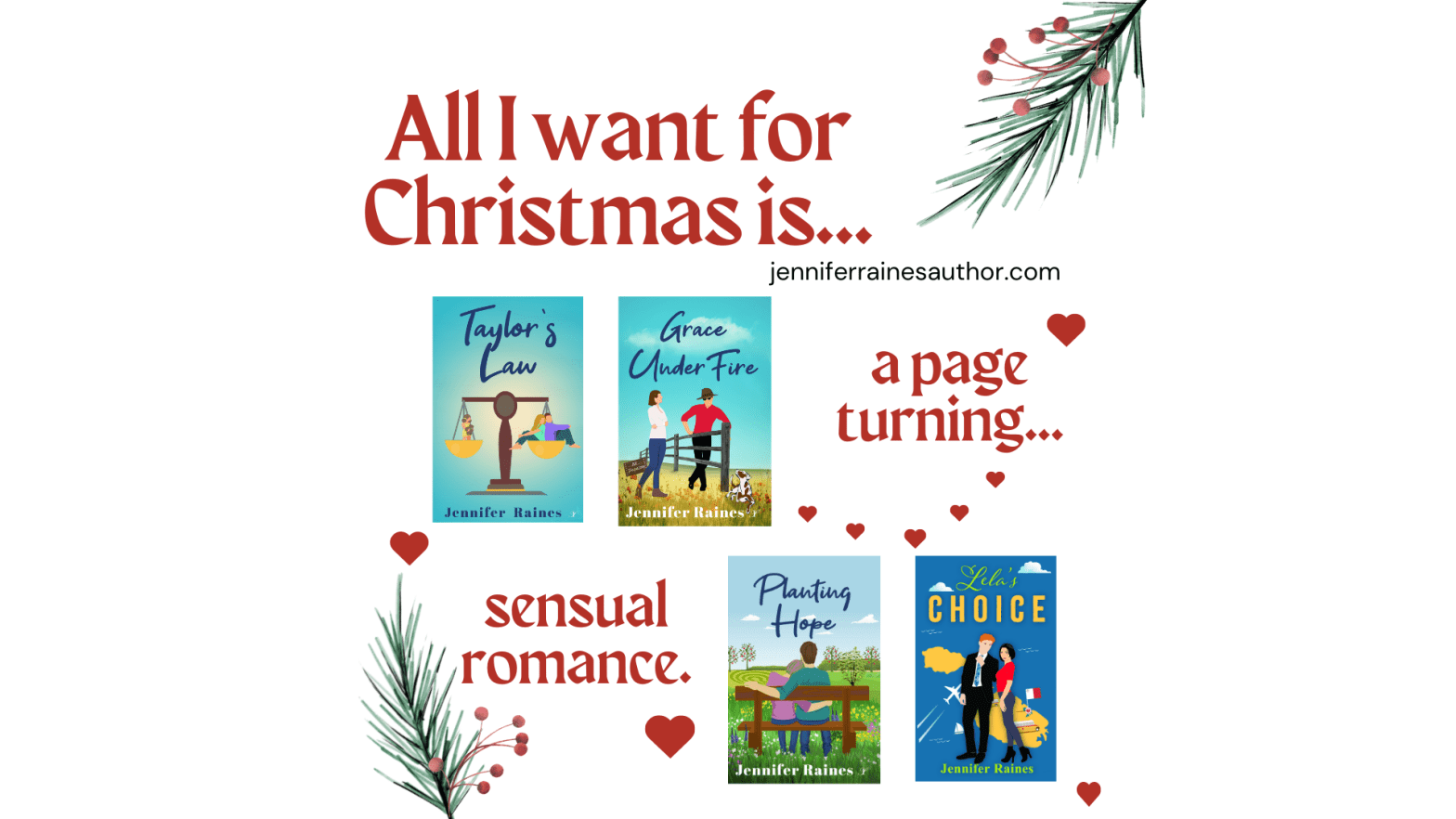
Taylor’s Law—The Anderson Sisters Book 1, July 2022

Romance Writers of New Zealand Koru Awards 2023—Best First Book—Second Place

Eleanor Anderson answers a summons to lawyer Jake Taylor’s office to discuss paternity and possibly custody of her two-year-old niece. Ella’s sister died without revealing the name of her child’s father, so what the hell is going on?

Grace Under Fire—The Anderson Sisters Book 2, February 2023

The staunchly independent dairy farmer Grace Anderson has been avoiding Ryan Wilson for years. Tricky when they’re neighbours. Ryan knows she was his brother’s best friend, knows he let her down when his brother suicided ten years ago, but he’d not been much more than a kid himself, and if he hadn’t locked everyone out, he’d have exploded with rage and grief. Now circumstances have forced Grace to ask for his help. Will he say yes? What does he want in return?

Planting Hope, a standalone contemporary romance, July 2023

Bohemian Holly Cooper arrives exhausted and filthy at her grandmother’s home after driving non-stop for hundreds of kilometres. Her grandmother’s business partner, loner Kit Silverton, fumes that she’s taken her own sweet time arriving to see her injured grandmother. He’s supremely pissed when the pink and green haired vagabond closes the door in his face.

Lela’s Choice, a standalone contemporary romance, December 2023

Lela Vella lands in Malta desperate to discover why her orphaned niece has fled Australia, only to discover her father’s henchman is ahead of her and expects her to follow instructions. Never going to happen. Hamish McDonald expects cooperation, not suspicion, and he has zero patience with guardians and caregivers who weaponise children in a fight between adults. What’s a workable truce look like when they’re both keeping secrets?

Masquerade, Choosing Family Book 1, March 2024 introduces two sets of identical twins.

The Australian Romance Readers Association (ARRA) is hosting A Romantic Rendezvous across 4 Australian cities in March 2024—Brisbane (9th), Sydney (10th), Melbourne (16th) & Perth (17th).

ARRA is inviting fans of romantic fiction in all its guises to gather together to celebrate our shared passion.

I’ll be in Sydney and am looking forward to meeting new and existing readers. I’ll have some paperbacks for sale, but my books are available as e-books from all major booksellers and paperbacks from Amazon and Barnes & Noble. Also ask at your library, and if you’ve found my books that way, I’d love you to stop by and say hello.

To discover which authors are appearing at which venues check out the author list

To enter the draw for a free ticket at the venue of your choice just email me using the contact form on this website.

Subscribers, and the winner, will be notified by 23 December 2023—an early present for the New Year.

Find me on:

You can also contact me directly via the contact page on my website if you have any questions.

Lela goes to Malta

I’ve always been aware of Malta, of its history and beauty, largely because of family friends and colleagues, whose parents and grandparents emigrated from Malta to Australia. They’ve returned to Malta on visits, to reconnect with family history or on stopovers between Australia and Europe, staying for a few days or a few weeks. This gave me my setting for Lela’s Choice and the idea of a whirlwind romance.

I chose Malta for another reason. Malta, like Australia, is a signatory to a number of international conventions and treaties. I took a bit of licence with the idea of an Australian lawyer being in Malta to discuss the details of international treaties, although the Australian Attorney General’s Department is involved in negotiations for treaties we sign. But it gave me a legal nerd—Hamish—as my male lead with a legitimate reason for being in Malta.

At the time I started writing this book there were a few big cases—there still are—of children being taken across borders after relationship breakdowns. Australia is a signatory to the Hague Convention on the Civil Aspects of International Child Abduction, the main international agreement that covers international parental child abduction. So is Malta. Not all countries are.

One parent may permanently lose access to their child or children if countries don’t accept the rights of a non-citizen parent, so the notion of the abduction and return of a child was added to my story mix. In NSW, anyone under 18 is legally a child.

Trouble is, a story about total family dysfunction doesn’t lend itself to romance. But what if I had a runaway—with cultural connections in two countries—who fled across a border? What if she’s 17, an adult, but not quite an adult?

That left me needing a female lead. And so I met Lela. Her parents emigrated from Malta to Australia some decades ago. She’s chasing her adored runaway niece. Frantic, Lela catches the first flight from Australia to Malta. On arrival, she discovers her father has co-opted a serious legal eagle, Hamish, to assist in the return of our abductee/runaway, and Hamish is ahead of her.

I mixed families, intergenerational conflict, runaways and meet-in-a-bar-marry-in-Vegas scenarios. Hey presto, I had my book.

Lela and Hamish take it from there—a swoony, combustible romance. I hope you enjoy it.

I write a monthly blog on my website where you can find out what I’m up to. You can also find me on FaceBook and Instagram

You can find my books at major booksellers, or through the My Books page on my website.

  • Lela’s Choice—Release 5 December 2023
  • Taylor’s Law—The Anderson Sisters Book 1 (Second Place Romance Writers of New Zealand Koru Awards 2023—Best First Book)
  • Grace Under Fire—The Anderson Sisters Book 1
  • Planting Hope, a standalone slowburn contemporary romance.

Find me on:

You can also contact me directly via the website if you have any questions.

Hanging out, Hooking Up or Happily Ever After (HEA)

As a romance writer, I’m fascinated by romantic relationships—the way they work, how people meet, what creates a spark or a connection, why one relationship lasts and another fails. However, perceptions of romantic love and how people feel, think, and behave are influenced by culture. I’m an open-minded heterosexual white woman in Australia.

I’m also a mere novice in this game. Psychologists, sexologists and relationship counsellors study relationships, write about relationships and counsel others about relationships. Analysing and advising on relationships are all serious business in today’s world. Looking at a random selection of titles, you can pursue any research direction that takes your fancy:

  • Act with Love: Stop Struggling, Reconcile Differences
  • The State of Affairs: Rethinking Infidelity
  • How to Heal from Heartbreak: A breakup journey
  • Finding Love After Divorce
  • You are the one you’ve been waiting for.

I’m not sure if today’s focus on relationships makes them easier or harder to navigate, although all these books have insights to benefit some readers. I’d also add that this blog isn’t looking specifically at loneliness which plagues people of all ages and genders, including some in settled relationships.

In the olden days—back before social media perhaps—people in western cultures would date. Multiple dates would add up to courtship and relationship building.

A few years ago, I heard a talk by Dr. Jodi McAlister, who studies, among other things, representations of love in popular culture. She has an impressive body of research work, including researching The Bachelor. Jodi is also a romance author. Her topic that day was “the perfect date”, and I’m cherry-picking her words for this blog. For example, you respond with your heart in date 1, with your head in date 2, and with your genitalia in date 3. All sorted!

Jodi observed that many young people today avoid the terms date or dating. There’s a tendency to use non-dating terms: hanging out, talking to each other, seeing each other, getting to know each other. She noted the terms were deliberately non-committal, and groups of young people might hang out together.

There are other shifts. Dating, and its implication of a person being off the market, has been replaced for some by hook-ups and dating aps. There’s a bit of irony in the label—dating aps—when often the intention of one or both partners isn’t to have a monogamous relationship, or even a relationship that lasts longer than a few messages and a meetup. The impact of this trend has also become fertile ground for research.

Jennifer Pinkerton says she wrote Heartland: what is the future of modern love because in a world of dating apps, omnipresent porn and increasingly fluid identities the question becomes: what is the future of modern love? Her book is based on reportage, memoir and research, including 100 interviews with diverse people under 40 hearing about their values, preferences and anxieties about their dating lives. “From transgender Aboriginal sistagirls in the Tiwi Islands to conservative Catholics living in Sydney, this book explores … romantic relationships at a time marked by great expectations and far fewer rules.”

I heard Jennifer Pinkerton interviewed recently. I was struck by her comment that at one point during her interviews for Heartland, she took time out to interview some older couples who had had long and happy relationships and asked them the secret to their success. Three words: respect, reciprocity and equality.

In my romance writing, I’m trying to deliver a believable happily-ever-after as well as a good story with a satisfying smoulder. So for me those three words make a lot of sense, and are central to the characters I create.

You can find my books at major booksellers, or through the My Books page on my website.

  • Taylor’s Law—The Anderson Sisters Book 1 (Romance Writers of New Zealand Koru Awards 2023—Best First Book-Second Place)
  • Grace Under Fire—The Anderson Sisters Book 2
  • Planting Hope, a standalone slowburn contemporary romance
  • Lela’s Choice—Cover reveal & preorders 14 November, Release 5 December 2023.

Find me on

You can also contact me directly via the website if you have any questions.

Backstory

For a variety of reasons, I’ve been thinking about backstory lately.

Backstory is the history that has made your characters who and what they are. In last month’s blog I paraphrased Shannon Curtis who conducted a craft session on backstory at the Romance Writers of Australia Conference. Backstory, of necessity, includes the emotional shrapnel embedded in our character(s)—the wound; their bedrock belief, which is in fact a misbelief built on flawed, yet convincing logic. And their fear—whether real and well-founded or perceived. Because of this fear, the character changes their behaviour to avoid threats, and this prevents him/her/they from finding love. Characters become whole at the end of a romance through the transformative powers of love and courage.

Backstory is what allows readers to relate to characters. There are all sorts of rules and prohibitions about when you reveal backstory, and it’s easy to get tripped up. A common criticism of new authors is “you’ve given the reader too much backstory too soon”. The solution is to dribble in the backstory, because if you give away too much too soon, you dilute your story’s tension. So hoard your backstory, as Grace Burrowes says, and never answer a question until the reader has been asking it for a few pages.

If the theme of romances is love conquers all (Gwen Hayes, Romancing the Beat); or rather love conquers distrust, or betrayal, or loneliness, or abandonment, or shame, or something else, then backstory is the “all”.

In my current work in progress, the main protagonists play a critical role in each other’s backstories through a shared traumatic incident. This past complicates their present. So, we’ve got guilt, regret, atonement and unworthiness all scrambled together. They need to forgive each other as well as themselves. Without empathy, my characters, who are perfect for each other, won’t be able to build a positive, shared future.

Authors invite their readers to empathize with their characters, and the best books achieve this.

But backstory is critical to every human being. While authors focus on the specific characters we’ve selected for our stories, each person you pass in the street has a backstory. Do we empathize with strangers in the street, people we’ve never spoken to or met? Would it make a difference to our shared world if we tried to understand what has shaped their life?

I’ve also been thinking about this recently because of political developments in Australia. We’re having a Referendum to change our Constitution. It seems pretty uncontroversial; recognise First Nations people as the original owners of the land. A no-brainer because they were here when white settlement occurred, and we are one of the few countries on earth where settlers didn’t sign a treaty. Recognising First Nations people in the Constitution is a straightforward correction of an historical wrong.

The second part of the question is about establishing a permanent advisory body of First Nations people to advise the Parliament and Executive on policies that directly impact Indigenous communities. We’ve had advisory bodies before, but with no requirement for permanence, a change of government can mean existing bodies are abolished, and expertise and knowledge of issues that impact First Nations people are lost. This notion of a permanent advisory voice, designed by Parliament and regulated by whichever party is in government, seems to be trickier for a lot of people, and has been a touchstone for a deluge of misinformation, deliberate lies, and personal attacks on First Nations individuals.

I can’t help but feel that backstory is playing a role here too. Some people are uncomfortable with the notion that the actions of their grandparents and great-grandparents influences what happens today, but ask anyone who’s just received a DNA test result that tells them their beloved grandfather isn’t in fact any sort of relation to them, and the past becomes integral to the present.

Nations across the world still struggle with their histories, the conversation on reparations for slavery is fraught, and historical genocides are still disputed. There are many difficult questions and answers in Australia’s history with its First Nations people. Many see voting yes in the Referendum as a chance to listen to the lived experience of Australia’s First Nations people and move forward with courage and love.

You can find my books at major booksellers, or through the My Books page on my website.

Taylor’s Law—The Anderson Sisters Book 1 (Second Place‑Romance Writers of New Zealand Koru Awards 2023—Best First Book)

Grace Under Fire—The Anderson Sisters Book 1

Planting Hope, a standalone slowburn contemporary romance

Lela’s Choice—due out in December 2023.

Find me on

Collective Creativity

Over the long weekend of 10-12 August Romance Writers of Australia held its annual Conference in Sydney—All That Glitters.

My resident pedant says the line originates with Shakespeare “all that glisters is not gold”, but perhaps organisers were inspired by Kate Earl’s, All that Glitters with its links to 1930s jazz tones. Doesn’t matter, the conference offered lots of fascinating people, interesting conversations, excellent craft sessions, glittering costumes, and shared laughter.

In my experience, writers can hear the same talk or read the same article twice and have completely different reactions depending on where they are in their writer’s journey. At #RWAUS23 the session by Shannon Curtis: Mining the Back Story for Gems spoke to me. The title didn’t do justice to a session that was both informative and fun—spot on advice delivered by an outstanding teacher/presenter.

Shannon reminded us of the universal truth of romance, that while “neither character is perfect, they’re perfect for each other”. Motivation is “what they think, feel, or why they act the way they do, which is backstory and thus drives action/reaction and decisions and directions”.

We’re looking at—and I’m paraphrasing Shannon here—the emotional shrapnel embedded in our character—the wound; their bedrock belief, which is in fact a misbelief built on flawed, yet convincing logic. And their fear—whether real and well-founded or perceived. This fear changes the character’s behaviour to avoid threats, and thus prevents them finding love.The fun part was Shannon interspersing her talk with questions to the audience to build a character, identify their wound, their misbelief, and their fears to chart their journey/arc from hole-hearted to whole-hearted.

Question 1: Male or female?

A fast thinker from the front of the room—male.

Question 2: Name?

A quiet, considered voice—Arthur, which occasioned much hilarity and apologies to any Arthurs present.

Question 3: Wound?

He was kicked in the head by a horse as a child—not an idea I’d ever have come up with.

Question 4: Triggers to this memory?

Shouts from around the room as participants started rooting for Arthur—the smell of hay, a horse neighing, horse races.

Question 5: Arthur’s reactions to the triggers?

He might freeze, clench his jaw, have a flashback, feel anger, fear or helplessness—you the author get to make these decisions for your personal Arthur.

Question 6: What are Arthur’s defences?

Giggles grew louder—Arthur avoids farms despite working as a farm agent, he works at a horse abattoir, he takes up martial arts or hobbies that require helmets. Like polo? muttered one wit.

Question 7: What are Arthur’s avoidance tactics?

He pretends he’s allergic to horses; he delegates his farm visits to other staff. I will not be writing Arthur’s story.

Have you worked out by now that Arthur must fall in love with a character who raises horses, rides horses, can’t live without a horse in his/her/their life.

Question 8: What’s Arthur’s lightbulb moment?

Shannon’s audience was in full creative flight—Arthur discovers it wasn’t a horse that kicked him in the head, or he learns horses aren’t terrifying by birthing a foal. Right, sticking your arm up a horse’s uterus is going to convert you to loving horses! Then again, Arthur could discover that his father is a shape-shifting stallion. Thus we leapfrog romance genres to shapeshifting romance. Whatever, Arthur emerges feeling strong.

By this time, the bells had started ringing to end Shannon’s session. I didn’t want it to end, and the ideas are still swirling in my head a week later because we left Arthur hanging, with his figurative trial by fire ahead of him. Just how did he move beyond fear to his happily-ever-after?

You can find my books at major booksellers, or through the My Books page on my website.

Taylor’s Law—The Anderson Sisters Book 1 (Second Place—Romance Writers of New Zealand Koru Awards 2023—Best First Book)

Grace Under Fire—The Anderson Sisters Book 2

Planting Hope, a standalone slowburn contemporary romanceLela’s Choice—due out in December 2023

Lela’s Choice—due out in December 2023.

Find me on

You can also send me a message via the contact link on this site. Looking forward to hearing from you.