
Toxic, for you, romance tropes?

Recently I read an article by Zoe Williams (The Guardian 28 Sept 2026 ) entitled Gen Z has very strong opinions about age gap relationships—and it could be right.

To save you looking, Gen Z are those born between 1997-2012, that is between 13 and 29 today. The gist of the article is that once upon a time “older men and younger women were an unremarkable screen pairing”, but this has changed.

Williams’s raises the topic in the context of the new film adaptation of Jane Austen’s Sense and Sensibility, where the original text includes a 19 year age-gap relationship between Marianne and Col Brandon. The 1996 Australian release used actors aged 50 and 21, an actual age gap of 29 years. Williams’s argument is that while the new version used a smaller actual age range for the actors:

“The average gen Zer thinks an age gap of a single school year is a red flag of exploitation. So the film-makers got Herbert Nordrum, who is only 13 years older than Esmé Creed-Miles, but – per my point about school years – this is still way too many.”

“Often, when you watch a classic film with youngsters today and they’re doing wild vomit-mimes and yelling: ‘No, seriously, what is wrong with you people?’ it’s not immediately obvious what they’re objecting to. It could be that what you thought of as a sudden and dramatic romantic clinch assumes consent that has not been expressed, or it could be that the woman is visibly 15 years younger than the man, or it could be something else entirely, like: ‘She is quite cool and he is a jerk.’”

But Williams and the young people she spoke with made me ask myself some questions.

Romance tropes are everywhere these days, there are classes on them, articles about them, books listing them, recommendations to promote/market your books by trope so that your readers know exactly what they’re getting in advance—despite no two authors writing a trope in exactly the same way.

Believe it or not, considering whether a trope encourages good or poor behaviour in real relationships is a dilemma for me. Romances are about escapism and fantasies. Who am I to dictate what turns you on, but I continue to question whether the fantasies we write influence how our readers recognise or engage with romance in real life.

That may be arrogant of me, although, it seems I’m not alone. Searching for answers I came across a few interesting summaries of romance tropes that authors and readers see not only as not romantic, but as actually toxic.

I’ll give you one of my own. I don’t find vigilante justice, although this sometimes travels under the super protective guy trope, vaguely romantic. In fact, it scares the bejesus out of me that an individual decides they’re judge, jury and executioner of another human being. Anyone who says they’ll destroy anyone who’s ever hurt me, down to the person who gave me the finger in the carpark this morning, doesn’t make me feel safe. I feel scared to open my mouth. I’m a law and order and agreed-rules of war kind of gal.

Sophie Carter writing in Momskoop on 11 June this year identified eight tropes that have red flags flying for her (I haven’t included them all).

  • Persistence always wins the girl or guy— In real life, continuing to pursue someone after they have said no is not charming persistence—it’s ignoring their boundaries.
  • Love can fix anyone— Loving someone deeply does not give you the power to fix them and is an unreasonable pressure to place on a romantic partner
  • Obsession equals true love—Loving someone means wanting good things for them, including their independence and happiness. A healthy connection lifts both people up rather than trapping one person inside someone else’s need for total control.
  • Constant fighting means strong chemistry—a relationship should feel like a safe place, not a battlefield you keep returning to.

I’m comfortable with Sophie’s assessments, but I also looked at someone who’d spoken to some experts. An article by Rachel Varina in Cosmopolitan on 31 October this year distinguished between red flags and personal preferences. Also, a single bad action may be just that—red flags are about persistent behaviours that can damage a relationship.

Varina refers to advice from Golee Abrishami, PhD, VP of clinical care at Octave Mental Health.

“Simply put, relationship red flags are warning signs that someone’s behavior could lead to an unhealthy or potentially unsafe relationship. Think dishonesty, disrespect, manipulation, or controlling behavior, rather than someone occasionally being in a bad mood or forgetting to text you back.”

Respect, honesty and safety appear to be the biggies. And they’re biggies for me when I write my romances. My books are for those who enjoy emotionally intelligent romance with competent people. So check out my books and let me know what you think.

What’s on the horizon for me:

My next release, Tainted, a standalone contemporary romance with suspense elements releases on 12 January 2027. Cover reveal and pre-orders are available from 15 December, which is approaching at bullet-train speed. The caption: When a suspicious lawyer opens her grandpa’s files, a police informant’s cover is at risk.

To be honest, the job of editing, formatting and reviewing Tainted has left my creative juices a bit flat. I’m just lifting my head and getting ready to review my current works in progress (WIPs); a return to Malta and Sophie Vella plus another book close to my heart set in Nepal.

I’m appearing at the Australian Romance Readers Association (ARRA)’s annual A Romantic Rendezvous events in March 2027 in Sydney and Canberra. The special guests have been announced. Amy Andrews, multi-published spicy romance author and Ilona Andrews, the husband and wife team writing urban fantasy and paranormal romance. Keep up to date on developments by joining ARRA’s Facebook page.

BTW: The e-book for Masquerade, my opener for my Choosing Family series, is on sale at $0.99 across all platforms from 26 November to 10 December.

Masquerade’s theme is the difference between being recognised and being known.

Two deeply guarded professionals, each an identical twin, are forced together while hiding multiple versions of themselves from the world and each other.

Find me on:

  • Diana Kathryn Penn’s Indie Reads Aloud podcast has recordings of me reading the opening 20 mins of my books:
    • Betrayal—Choosing Family Book 3 (episode 212)
    • Quinn, by design—Choosing Family Book 2 (episode 208)
    • Masquerade—Choosing Family Book 1 (episode 188)
    • Lela’s Choice (episode 143)
    • Planting Hope (episode 101)

You can also contact me directly via the contact page on my website if you have any other questions.
Factual, reliable, verifiable-it matters

Emotions motivate people. As a romance writer, I’m tapping into emotions, seeking empathy and engagement from my readers for my characters. Increasingly, in writing about love and equal partnerships, I feel like I’m in a zero sum game where themes of revenge, anger, punishment, hate and anger get more traction than cooperation and encouraging mutual growth.

We’re being bombarded by information from all directions, and if we use social media, at an unprecedented speed. We use information to make some of the biggest decisions in our lives. Who to trust is one of the biggest.

There’s evidence that people are increasingly turning to bots or agents for advice on actions, on finances, and increasingly on who to love or who to hate.

The proliferation of horror stories about trusted entities on the other end of a post urging young people to self-harm and to commit violent acts against vulnerable others in their orbit is horrifying. It seems to happen in the blink of an eye. The algorithms seem to lap up and magnify the angry, the vicious, the vengeful, the misogynistic and hateful.

How to find balance?

I was reminded the other day of a game known pretty universally as telephone whispers. One person whispers a message to another. By the time the message has passed through multiple people, it’s not the same as the first message. This can be entertaining, but also teaches players how easy it is to get a message wrong.

While this is a game, it’s also an area for research used to identify the type of information that is more easily passed from one person to another. Reasons for changes include anxiousness or impatience, erroneous corrections, or the difficult-to-understand mechanism of whispering.

At the end of a game of telephone whispers, the correct message is given to everyone to compare against what they heard. In our digital world there’s the inference that every message is  one hundred percent correct.

Anxiousness or impatience as a reason for mixing up a message tapped into something else I read recently. Hannah Ewens, a freelance editor and writer wrote an item for The Guardian on 27 September 2026 entitled My Instagram reels addiction has ruined my ability to have a conversation. But can I get it back?

After spending  a lot of time on reels, she noticed a new impatience in her conversations with others. That the time spent, particularly on reels, catered to her as an individual

“started competing with real-life interactions. Subconsciously, I had begun to expect conversations to provide speed, relevance and the ability for me to skip through at will.”

Some of her friends and colleagues were having the same feelings. She asked experts for advice. In conversations you have to retain information and wait to reply, whereas the impatience you feel from too much digital short-form content encourages you to switch topics, interrupt, drift off or pick up the pace. Hannah’s conclusion is that

“the best conversations are nothing like content. They aren’t all sparky like electricity but take on the form of water. They allow me and another person to meander, to seep into places we have no business being, to become emotional. We push and pull and create a unique tide between us. There is no “hook”. No frenetic pace. Any clear takeaway is often submerged by more questions. Sometimes it’s boring but often it can be quite beautiful – if you have the patience for it.”

Stories are the same. You need to take time to read, reflect and submerge yourself  for periods of time. We lose a whole lot of magic by going for the digital short form interaction, especially when the short-form is often curated by people who aren’t interested in letting us grow in new and diverse ways, but shift us towards dark and lonely spaces.

My takeaways—talk to people, including strangers, read more, relax in nature, go fishing.

What’s on the horizon for me:

My next release, Tainted, a standalone contemporary romance with suspense elements releases in January 2027.

Poppy Madsen’s not exactly in hiding. Yet. This trip’s a quick in and out of her home town to see where her grandpa’s buried and say her final goodbyes.

Grandpa banished her. Told her never to return, then pointed forensic accountant Poppy in the direction of her parents’ company, pushing her to bring them down. Family honour demands it. Now whispers are swirling about her role in their company, and government agencies are squabbling over jurisdiction for the impending court case.

Mitch Watkins, a small town lawyer and Ivar Madsen’s executor is now living in Ivar’s house. He bore witness to Ivar’s grief at Poppy’s abandonment. He doesn’t trust Poppy. She’s the enemy—right?

Mitch and Poppy circle each other. Both have learned to ration trust, but can’t deny their growing attraction. Daily, they cross boundaries they vowed not to cross, but can’t resist.

Is Poppy tainted by her family’s crimes, or has everyone mistaken her for something she isn’t?

I’ve actually got two works in progress (WIP). I’ve told you about Sophie’s Apology (tentative title) but the other piece is set in Nepal and is called Conquering Nick. It’s a book that’s been in my head a long time. I’d started work on it before the recent devastating glacier collapse and flood in Nepal. I’m continuing because Nepal is an incredibly beautiful country with wonderful people.

I’m appearing at the Australian Romance Readers Association (ARRA)’s annual A Romantic Rendezvous events in March 2027 in Sydney and Canberra. The special guests have been announced. Amy Andrews, multi-published spicy romance author and Ilona Andrews, the husband and wife team writing urban fantasy and paranormal romance. Keep up to date on developments by joining ARRA’s Facebook page.

Find me on:

Betrayal—Choosing Family Book 3 (episode 212)

Diana Kathryn Penn’s Indie Reads Aloud podcast has recordings of me reading the opening 20 mins of my books:

I have a confession to make …

I am advert/promo blind. From the time I was a small child, my gaze would skate across ads, looking for the actual stories. I can hypothesise that we couldn’t afford many luxuries when I was a child. Being sucked in by ads was bound to end in heartache, so I trained my brain not to see. Whatever. In the current world, and as an author, this is a severe handicap.

How ads work is an alien language to me. Again, I can hypothesise that I write great, contemporary romance with relatable characters facing real issues who earn their happily-ever-afters, and that the books should speak for themselves. My males are the ultimate fantasy, sexy and thoughtful, passionate and also having their woman’s back. There’s spice, too much for some, not enough for others but hopefully perfect for the characters I write.

Other writers write terrific, excellent, mind-blowing books too, and if you want to be seen and picked up then you have to be on the socials and you have to be eye-catching.

A long time ago I saw a quote from a book called Toxic Sludge is Good For You: Lies, Damn Lies and the Public Relations Industry by John Stauber & Sheldon Rampton (1995, most recent edition 2011). A note from their first edition:

“Academicians who study media now estimate that about 40% of all ‘news’ flows virtually unedited from the public relations offices, prompting a prominent PR exec to boast that ‘the best PR ends up looking like news’.

… the fact that the 150,000 PR practitioners in the US outnumber the country’s 130,000 reporters (and with the media downsizing its newsrooms, the gap is widening)”

I found it scary then. It’s on ‘roids now. What’s real? How do you know something is real or good? Your favourite influencer told you so? Their best friend told you so?

The impact of reading Stauber & Rampton’s book on me is that I always verify the source of my information. With the passage of time, the book’s thesis resonates more strongly. In the current world promotion, not substance, is the stuff that counts.

Large publishing companies have branding and marketing departments, whereas small and indie publishers usually lack the expertise and funds to make an impression. Increasingly, large publishers are also outsourcing their marketing to authors, picking up a new author when they have a proven track record of followers.

So, as an author with a small publisher, I either buy in the expertise or master the skills myself. Social media adds the extra complication, or so it seems to me, that I am the product, not my writing but me. Audience fascination with the person behind the story is as voracious as the growth of PR in the past and the persona, not the product, can be as false as the idea that toxic sludge is good for you.

I don’t want to be the product.

Sadly, the entire point of this is that I have to change. I can’t glaze over at adverts or promos. I need to study them, learn from them, apply them to myself and my work and go forth and conquer the world, that is, sell my books. The fantasy of a publicist saying, Jennifer, let me handle all of that for you in return for first edition signed copies of your books is just that, a fantasy.

So, now for the hard grind. If anyone has any ideas—easy, free or cheap preferably, on how to become a bestseller, please drop me a line. Because I’d rather be writing.

What’s on the horizon for me:

My next release, Tainted, a standalone contemporary romance releases in January 2027.

Honour or loyalty—which would you choose?

Forensic accountant Poppy Madsen sacrifices her home and her reputation to her grandfather’s crusade for justice. Lawyer Mitch Watkins believes she’s guilty as hell, but his gut or his gonads keep telling him there’s a bigger secret here.

📌 divided loyalties

📌 heroine in hiding

📌 secret world

📌 forced proximity

📌 making love vs a one-night stand

My current work in progress (WIP) is a companion book to Lela’s Choice, You remember the outline:

Lela Vella’s teenage niece flees to Malta. Terrified by what she might find, Lela chases her, only to be met by her father’s newest hitman, Hamish McGregor, a lawyer intent on reaching her niece first. Despite mutual suspicion, attraction smoulders. In the race to find Lela’s niece first, will they choose compromise or walk away from love?

My WIP is about the niece, Sophie. And Sophie’s had a few ups and downs since we last met the soon-to-be eighteen-year-old runaway. She’s twenty seven now and back to explain why she left Piet and Malta without a word.

I’m appearing at the Australian Romance Readers Association (ARRA)’s annual A Romantic Rendezvous events in March 2027 in Sydney and Canberra. The special guests have been announced. Amy Andrews, multi-published spicy romance author and Ilona Andrews, the husband and wife team writing urban fantasy and paranormal romance. Keep up to date on developments by joining ARRA’s Facebook page.

Find me on:

  • Diana Kathryn Penn’s Indie Reads Aloud podcast has recordings of me reading the opening 20 mins of my books:
    • Betrayal—Choosing Family Book 3 (episode 212)
    • Quinn, by design—Choosing Family Book 2 (episode 208)
    • Masquerade—Choosing Family Book 1 (episode 188)
    • Lela’s Choice (episode 143)
    • Planting Hope (episode 101)

You can also contact me directly via the contact page on my website if you have any other questions.
Kiss N’ Tell

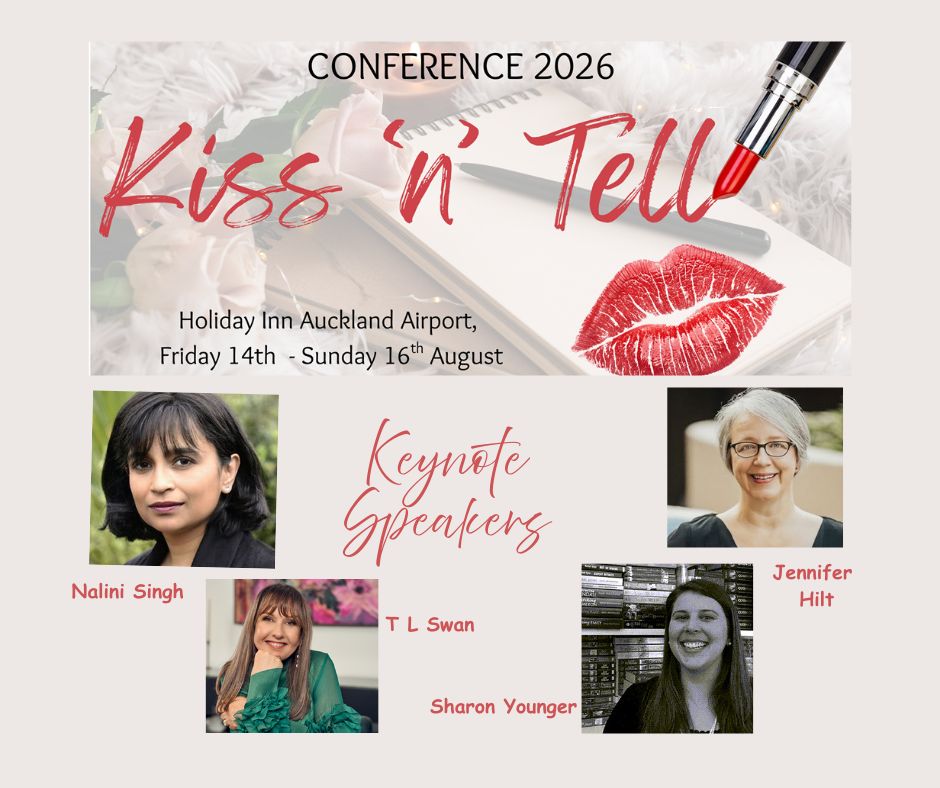
Spark your dreams, Fan your passion, Ignite your story  was the motto for the Romance Writers of New Zealand 2026 Conference. And it was a fabulous affair.

Unfortunately I missed the Friday workshops, but the reports I heard were glowing. Jennifer Hilt, author and creator of The Trope Thesaurus: An Author Resource on The Emotional Blueprint: How Tropes Create Character, Conflict and Chemistry delivered the keynote. James Blatch, a director of Self Publishing Formula Limited, an online course provider for independent authors and co-host of the weekly SPF podcast spoke about Book Visibility in the Age of AI. Participants were buzzing as the conference proper started on Saturday morning.

T L Swan, a best-selling, award-winning  author of “addictive, heart-pounding romances with witty banter, emotional depth and swoon-worthy heroes” gave Saturday’s keynote. For me her key takeaways were:

  • nail the brief—that’s title, cover, blurb—when a book’s not selling rebrand. T did 9 rebrands on 6 of her books, that’s changing the covers and blurbs until they hit the reader sweet spot
  • don’t sell on tropes, satisfy on emotions
  • you need to know the major conflict and how it ends
  • give ARCs away like water—you want readers
  • chapter analysis—3 things should happen, you should leave 3 clues for later and end on a cliff hanger
  • first chapter and blurb are critical (that’s your selling sample on Amazon)
  • understand how KU and Amazon work and use that to work for you.

Sarah Young, Executive Agent at the Nancy Yost Literary Agency represents authors across romance, women’s fiction, and commercial fiction. Sarah love love loves her job and talked about what an agent can do for indie, trad or hybrid authors, specifically in protecting your contract rights. These days rights can cover print, e-book, audio, film, foreign, translation, performance, serialisation, computer/app games, manga/graphic novels and merchandising and may be sold separately.

Sarah is embedded in the publishing industry and can provide professional and editorial guidance. Sarah emphasised the importance of an author knowing what they want from their career and agent. You interview the agent as much as the agent interviews you. Sarah took pitches at the conference and there were some very happy new authors after their 1:1 meetings with her.

A session on covers appealed, so I attended Holly Dunn’s Covers and Comp Titles: Maximising Market Success. As an illustrator and author Holly has particular insight into what an author needs for their book PLUS she reads the manuscripts she illustrates and usually hand letters her covers. What more could you ask for! She suggests that:

  • your cover sets up a promise that your book delivers on
  • you want to fit in more than stand out, to have LEGS—be legible, eye-catching, genre specific and story relevant. Typology can indicate genre
  • she’s interested in your ideal reader, although readers are on a continuum eg. protagonist age range, reality of world, no magic to magic, time period, tone, place of romance in the story, level of mystery etc
  • colours should be consistent with genre

Sunday morning started with a bang. Jenny Nagle, CEO NZ Society of Authors talked about what an authors’ society has to offer authors, including romance authors, and it’s a lot—like minded people and craft courses for a start.

New Zealand’s own Nalini Singh, “internationally bestselling author of the iconic Psy-Changeling and Guild Hunter series of paranormal romances was the Sunday keynote. She also writes fun, contemporary romances and atmospheric NZ-set thrillers. Nalini’s sold over eight million copies worldwide and been translated into more than twenty languages. Nalini’s a generous, knowledgeable speaker who shared insights into how to thrive in the current market. She outlined key areas of focus:

  • mindset and personal goals—commit to the long term, it’s important to keep growing, know what you want long term and what you enjoy doing
  • creative foundations—write a good book, be careful of hyper-contemporary cultural references, don’t be scared of being a distinctive voice, keep your promise to the reader, the HEA
  • capacity to pivot—eg. genres, indie to trad or vice versa, length of manuscript
  • understand your bundle of author rights, what you give away and what you retain in specific contracts
  • understand your contract—not just rights, but AI clauses, reversion clauses, audit clauses, accounting (joint or separate) and ability to negotiate
  • financial literacy—you might be paying taxes
  • manage your business, time, inputs as you grow, delegate, use contractors where it works for you
  • take care: Give yourself grace eg. schedule 4 days a week, leaving a day free for unforeseen circumstances, use out-of-office messages when you need a break
  • develop positive professional relationships
  • look after your readers—don’t get a reputation for not finishing your series
  • direct communication with readers—social media is useful but shouldn’t be your primary communication with readers; use newsletter—check if subscribers want to stay
  • maintain a presence even in quiet publishing times eg. regular newsletter

And to blow your mind, the workshop on AI: risk, resilience and writing the future by Jenny Nagle and Daniel Watterson talked about what’s happening around the world to protect authors’ intellectual property as generative AI grows. The speed of change is supersonic. What’s needed are:

  • legislation—ensure transparency, labelling and enforcement
  • litigation— solving yesterday’s problems tomorrow; distinguishing types of copyright infringement—ChatGPTiseatingtheworld.com
  • licensing—need a new infrastructure for licencing

Authors can join the Human Authored program and use their logo on their works. At this stage this is limited to members of the UK Society of Authors, but they have been working with the Authors Guild in the US to launch the scheme.

The SPA Girls Session with Trudi Jaye, Cheryl Phipps, Wendy Vella and Shar Barratt was an engaging way to bring the focus back to me as an author, by taking questions and talking about how the SPA Girls maintain a successful author mindset:

  • most mindset problems are symptoms—imposter syndrome, perfectionism and self-sabotage usually trace back to a deeper root—not feeling worthy, safe or deserving. Work on the root, not just the symptom
  • comparisonitis is a career killer—someone else’s launch, rank or income report tells you nothing about your path. Stay in your own lane
  • words have power—listen to your negative self-talk—you can’t fix a story you haven’t noticed you’re telling yourself
  • find your people—a supportive writer tribe and positive accountability will carry you through the hard patches.

The final session of the day when energy is running low, I lucked out with the multi-talented Shannon Curtis and her session Use Theme Like a Queen. Shannon also operates Want2Write which provides resources for creative writers. The essential question for an author is what message do you want to convey. That’s your theme—”something that is threaded through the story, and we convey through plot events, character actions, motivations etc. This should be stated clearly, early in the book, potentially by a secondary character.” Examples of themes include:

  • trust
  • betrayal
  • forgiveness
  • caring
  • confidence
  • love
  • revenge
  • dealing with grief

Nalini Singh summed it up for me. You need to be patient with yourself and trust your voice.

This blog is for me as much as you because I wanted to keep the energy flowing after a wonderful and informative weekend. I can go back and reread it, plus I hope it inspires anyone thinking of joining me on this writing journey.

What’s on the horizon for me:

I’m writing a companion book to Lela’s Choice, You remember the outline:

Lela Vella’s teenage niece has fled to Malta. Terrified by what she might find, Lela chases her, only to be met by her father’s newest hitman, Hamish McGregor, a lawyer intent on reaching her niece first. Despite mutual suspicion, attraction smoulders. In the race to find Lela’s niece first, will they choose compromise or walk away from love?

My work in progress (WIP) is about the niece, Sophie. And Sophie’s had a few ups and downs since we last met the soon-to-be eighteen year old runaway.

I’m also appearing at the Australian Romance Readers Association (ARRA)’s annual A Romantic Rendezvous events in March 2027 in Sydney and Canberra. The special guests have been announced. Amy Andrews, multi-published spicy romance author and Ilona Andrews, the husband and wife team writing urban fantasy and paranormal romance. Keep up to date on developments by joining ARRA’s Facebook page.

A prompt: you can unsubscribe from my newsletter at any time. Don’t clutter up your email, if you’re too busy or no longer interested.

Find me on:

  • Diana Kathryn Penn’s Indie Reads Aloud podcast has recordings of me reading the opening 20 mins of my books:
    • Betrayal—Choosing Family Book 3 (episode 212)
    • Quinn, by design—Choosing Family Book 2 (episode 208)
    • Masquerade—Choosing Family Book 1 (episode 188)
    • Lela’s Choice (episode 143)
    • Planting Hope (episode 101)

You can also contact me directly via the contact page on my website if you have any other questions.
Out to the open sea

I was reminded of this song when I heard of Bernard Bolan’s recent death. The chorus is a favourite with older members of my family. Bernard wrote the words and music to Rose Bay Ferry in 1973 and the song reached #1 on the Australian charts in 1974. A gentler time perhaps, which is why it’s resonating with me at the moment. For some context—the Nicholson Brothers operated ferries on Sydney Harbour at that time.

Where are we going today, Mr. Nicholson?
Where is it going to be?
Don’t turn left, turn right down the harbour
And out to the open sea
Throw away your compass, right hand down
And it’s out through the Heads we go
So ho! let’s be merry on the Rose Bay ferry
If we run out of petrol we’ll row Yo Ho!
If we run out of petrol we’ll row

It’s that line “And out to the open sea” that’s caught my attention. Possibly Sydney winter doldrums, but gosh new places and new horizons hover like fireflies sparkling in the distance. Is this where I confess that I get seasick and a boating holiday wouldn’t be my ideal getaway?

What’s your ideal escape?

Is your idea of heaven a tent in a secluded part of wild woodlands or forest or beach? Do you want sand between your toes and grit in your swimmers, the musty scent of seaweed, waves rolling over rocks turning them blue-black, and multifarious shades of green and blue everywhere you look?

Do you prefer luxury? The limousine collecting you from home, transporting you to the airport, flute of champagne in hand. The business class flight (don’t want to go too over the top, do we? Fantasies don’t all need a flat bed?) and the person with your name on a sign waiting at the other end to take your luggage and escort you to a waiting vehicle. Part of the luxury is all those people saying—and what more would madam like?

The room, tent, caravan, whatever, must always have a view. Let yourself be romanced by:

  • tiled rooftops
  • a string of backyards where opera and lawnmowers make mish-mashed music
  • a narrow balcony across a narrow street with a violinist practising their craft
  • the sight of a vertical bridge rising in the sky leaving behind tram tracks, cars, cyclists, protestors and pedestrians—it’s real
  • a two-storey mural discovered on a wall when they demolished the building abutting it
  • barge traffic along the Rhine
  • a wombat crossing a clearing to disappear down its burrow in the Australian bush
  • a light breeze rippling through a tree, a susurrus to tickle your ears.

Writing this makes me realise I’ve never written a book about a vacation. No holiday romances for me, and yet they are a staple of the genre. It’s never even occurred to me to write a vacation romance, but given my restlessness, maybe this is the moment?

Do you have other ideas for escape? Is it as easy as closing the door on the teeming crowd, dimming the lights, turning off all devices and snuggling into a couch with a hot chocolate and a favourite book? I know some people who never read a book twice, who rarely read a book twice, who are horrified I might read a book twice, and then there are the closet revolutionaries like me who frequently return to a much loved book, seeing it as comfort food that nourishes in a dark world or a difficult time. I won’t confess how many times I’ve read some books, because that’s my secret to keep.

Is escape for you a walk through a park or trees having left devices behind? A moment to hear birds calling to each other, leaves rustling, small animals scarpering through the undergrowth? To exchange a smile with strangers and wonder about their story? To look at the sky and the endless variation in clouds? Walks refresh me. I’m often the only person without earplugs of some sort. I find those times when my mind randomly roams produce the best ideas.

For July, I wish for dreams to come true.

What’s on the horizon for me:

The Wrong Time for Love—The Anderson Sisters Book 3 released on 14 July and is available at all major booksellers. Reviews are starting to come in. My readers seem to like relatable characters grappling with life’s challenges and finding love and hope.

I’ve registered for Australian Romance Readers Association (ARRA)’s annual A Romantic Rendezvous events in March 2027 in Sydney and Canberra. More news on that as we get closer, but in the meantime you can join their Facebook page.

Find me on:

  • Diana Kathryn Penn’s Indie Reads Aloud podcast has recordings of me reading the opening 20 mins of my books:
    • Betrayal—Choosing Family Book 3 (episode 212)
    • Quinn, by design—Choosing Family Book 2 (episode 208)
    • Masquerade—Choosing Family Book 1 (episode 188)
    • Lela’s Choice (episode 143)
    • Planting Hope (episode 101)

You can also contact me directly via the contact page on my website if you have any other questions.