

Getting Published in Romance

I recently participated in a podcast where I was asked a number of questions by an indie romance author. The discussions in her podcasts are guided by questions she has about the industry, and which she hopes will resonate with other writers just starting out. She’s preparing a few podcasts before she goes live, but she was particularly interested when I mentioned associations.

That got me thinking. I joined Romance Writers of Australia (RWAus) very early in my writing career. A family member spotted an ad for a conference and suggested I attend. I felt very alone in the crowd, but I signed on as a member. I eventually did some time on the executive as the editor of the monthly newsletter. In those early days, it was a print and post to members newsletter which is very different from today’s attractive web-based version.

Reflecting on my past experiences, and where I am now, and what I know now, joining RWAus was an accidental, but brilliant, first step to becoming a published author. It opened up opportunities in a collaborative, supportive environment to enter writing contests, to attend conferences, to pitch to international editors and publishers, and to network with other beginning writers and published authors who have offered varying levels of support from being cheerleaders to mentors to early readers of my various masterpieces!

Along with the networking, membership of an association ran in parallel with the development of my craft. I expanded my membership of organisations to include Romance Writers of New Zealand (RWNZ), Romance Writers of America(RWA.org) and the Australian Romance Readers Association (ARRA).

The writers’ organisations all offered craft workshops either as part of a conference, online or via the monthly newsletters. Advice was  provided by multi-talented teachers and authors. Initially, most organisations and chapters offered competitions with editors and publishers as final judges. Winning a contest can be a great way to find a home for your manuscript. RWAus and RWNZ still offer competitions for both published and unpublished authors, but changes around 2020 in RWAmerica mean that fewer competitions are available to US chapter members.

I stopped writing for a while—life getting in the way—and when I started again, I reactivated my memberships. I was a bit of a silent member, sitting at the back of conferences, feeling uncomfortable about butting in on existing groups of friends or colleagues, but hey—get over it! Whether you are published by a large publisher, or a small one, or take the indie road, you are expected to sell yourself through social media and public appearances.

I found the perfect re-entry point through the Sydney based RWAus members. They have a monthly catchup and share writing progress, industry gossip, trends, and achievements or failures. Other members have answers to questions I’ve mulled over in private for some time. I go home invigorated and inspired after a meeting.

In fact, it’s as a result of this group that I attempted my first short story in 2025, and while I usually write third person POV, I experimented with first person POV, so I was thrilled to final in the RWNZ Story in a Chapter competition and to place third.

Writing is a solitary endeavour, and I take quite a long time to get to know my characters, so I can do justice to their story. Having encouragement from a wide romance writing community makes all the difference.

My latest release is An Accidental Flatmate—Choosing Family Book 5, although all my books can be read as standalones. The elevator pitch:

🔺Casildo and Beatriz, chance flatmates, friends to lovers, family expectations, and promises we come to regret …🔻

You can find me and my books here: website FaceBook Instagram

Find me on

You can also contact me directly via the contact page on my website if you have any other questions.

Accidents do happen!

Once upon a time, a friend told me that readers like series.

I’d always written standalones.

“Readers enjoy dipping in and out of the lives of characters they’ve already met”, they said.

So I girded my loins and decided to tackle a series. The Anderson Sisters. Two books. I’m not sure that actually counts as a series. The titles are Taylor’s Law and Grace Under Fire, but because I don’t want readers to feel they’ve been left hanging by a thread or one step from the edge of a cliff, they can each be read as standalones.

Have I said, I like standalones?

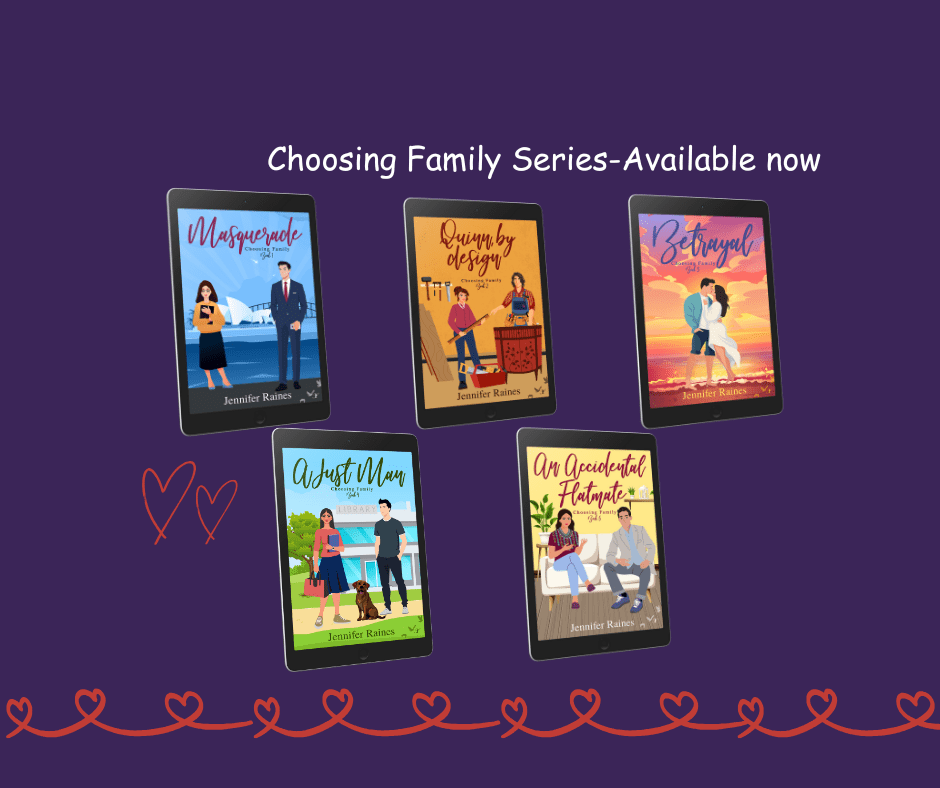
I decided to be bold for my next series and make it three books. I started with two sets of identical twins. Six individuals. One twin from each set fell in love with each other (Masquerade-Book 1), but the other twins found their true loves elsewhere (Quinn, by design-Book 2 & Betrayal-Book 3). The series is called Choosing Family.

I also started with the idea that life sometimes delivers thorns when you want roses, that is, you wake up to find yourself in a dysfunctional family. Families may have gone pear-shaped for any number of reasons—death, divorce, war, forced separation, ill-health, violence, poverty or just bad luck. But to balance that, all my books also offer examples of loving close families.

Yes, Virginia, there are happy families in the world.

In March 2025, I added A Just Man-Book 4 to the list. I had an idea looking for a home, and with some sleight of hand, it fitted the theme of Choosing Family.

And so we come to An Accidental Flatmate—Book 5 releasing on 8 July 2025. Although pre-orders are available now from your favourite bookseller.

Accident:

  1. an unfortunate incident that happens unexpectedly and unintentionally, typically resulting in damage or injury
  2. an event that happens by chance or that is without apparent or deliberate cause

In this book, I opt for the second definition. Neither of the main characters intended to share an apartment. They each arrived believing it was empty. But, hey, now we’re here, let’s see what happens.

And without conscious thought—can I say that when I actually created these people?— they both come from biggish, loving families. An accident? Or kismet?

Casildo and Beatriz both love their families, but sometimes love comes with obligations. Many migrant families struggle to gain their feet in a new country. Parents may carry obligations to support other family in their home country, as well as helping their children to flourish in a new land. Children may feel responsible to help their parents when their peers have no such responsibilities. Love is complicated. That’s what An Accidental Flatmate is about.

But as I often say, I write romance, so I look for the triumph of love and loyalty.

I’m taking a break from the Choosing Family series. It may be permanent, or I may discover characters who insist on being part of that world. The current set includes:

Masquerade—Book 1 🔺 a masquerade, a road trip, a steamy attraction and Kate & Liam discover the steps they took to protect their hearts might break them🔻

Quinn, by design—Book 2 🔺antiques shop owner Lucy vs woodworker Niall, a debt vs a gift, opposites attract, and then there’s that will…🔻

Betrayal—Book 3 🔺accidental enemies Anna & Hunter, a shared project, explosive secrets, but passion has its own rules …🔻

A Just Man—Book 4 🔺Kelly & Mick, old enemies, job sharing, house sharing, unexpected lovers, until the present bears an eerie resemblance to the past .. 🔻

An Accidental Flatmate—Book 5 🔺Casildo & Beatriz, chance flatmates, friends to lovers, family expectations, and promises we come to regret … 🔻

My next book is a standalone entitled Finding Cleo. It’s set in Helsinki, Finland with Australian characters due for release in March 2026. More about it later. Plenty of time for you to pick up one of my earlier books, if you haven’t already, and let me know what you think.

You can find me and my books here: website FaceBook Instagram

Find me on

You can also contact me directly via the contact page on my website if you have any other questions.

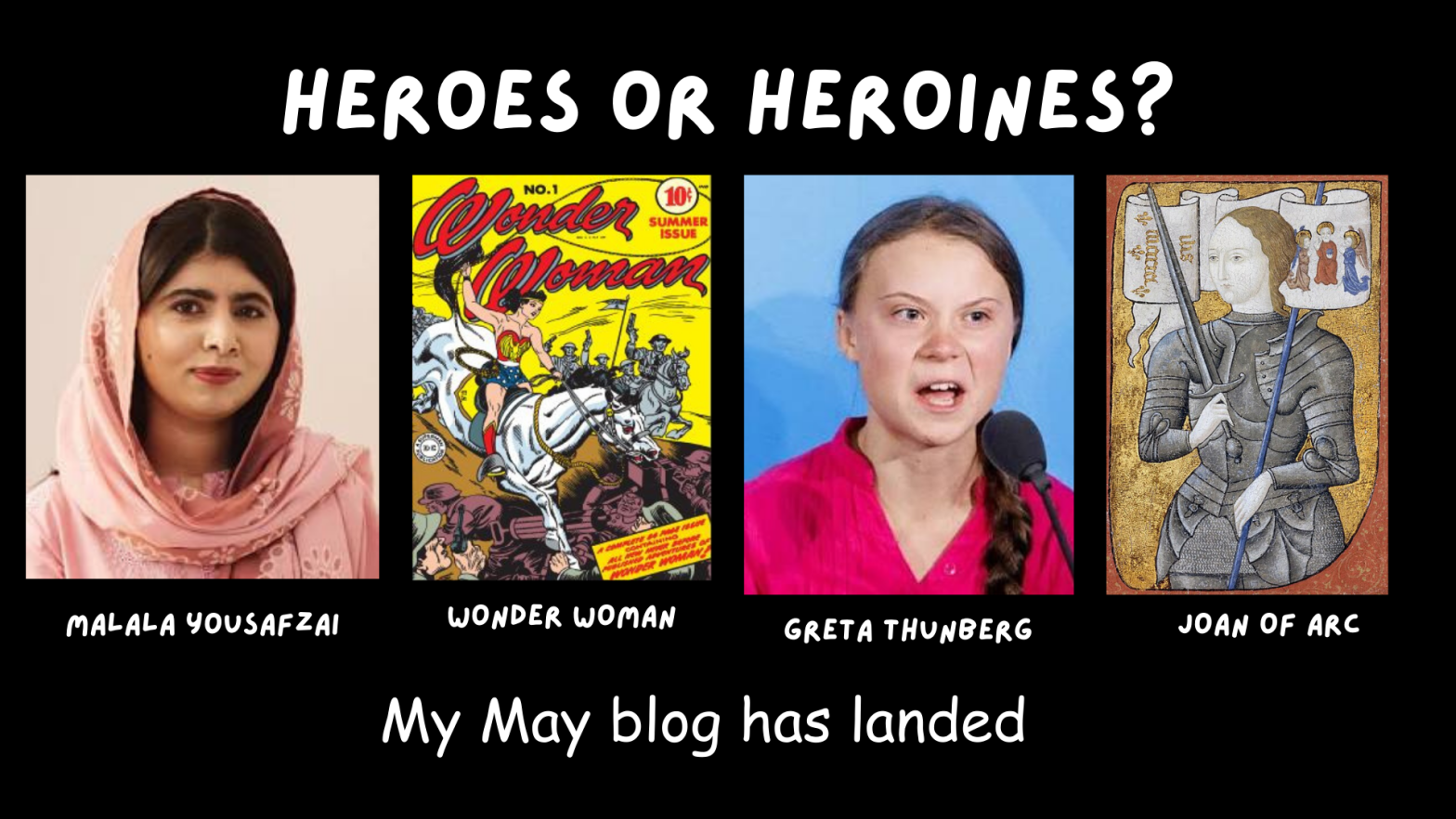
Hero or heroine—same, same but different?

I found myself going down this rabbit hole after reading  a recent article by Anastasia Safioleas on ABC online— Romantasy isn’t just hot, it’s shaping modern day fairy tales.

The article interviews Australian romance author and academic Dr. Jodi McAlister and some devotees/Tiktok influencers about their passion for the genre. As Dr. McAlister reminded us romance only has two rules, a central love plot and a happily-ever-after. Fantasy is about imagining impossible or improbable things.

Romantasy roughly translates as romance plus fantasy, and while the genre isn’t new, the term is. Current romantasy probably steps up the “steamy, graphic” sex compared to earlier stories, but world building is the genre’s strength. The appeal for many is the escape into a new, different and potentially wonderful world.

I was struck by the comment of one influencer, Sabine, who says she enjoys romantasy because “real life doesn’t cut it”.

“While contemporary or urban fiction is great and all, it doesn’t take me far enough. I want a full-blown escape. Send me to live with the Fae, teach me healing magic, and throw in a dangerously attractive, brooding ancient MMC  who falls hopelessly in love with a seemingly ordinary female lead. Bonus points if he’s ready to burn the world down for her. It’s the ultimate fantasy.”

MMC or main male character is a modern term, used instead of protagonist or even hero. FMC is a female main character, and if you pick up a romance with two MMCs, then you know what you’re getting. But how do these terms relate to hero and heroine?

The quote above talks about an action MMC ready “to burn down the world for her”, and a “seemingly ordinary female”.

The Hero with a Thousand Faces, Joseph Campbell, 1949  outlines the hero’s journey, a common narrative archetype, or story template, that involves a hero who goes on an adventure, learns a lesson, wins a victory with that newfound knowledge, and then returns home transformed.

Campbell’s work started an ongoing debate especially about what a reader thinks when they say or hear the word hero or heroine. I’m simplifying this for the purposes of my blog, but a lot of scholars and individuals have been uncomfortable with the assumption that hero and heroine are interchangeable words, when in fact they imply that certain “heroic” characteristics are only associated with males. 

The Afictionado blog argued in 2017 that 

we generally think of some sort of masculine Herculean or Superman-ish figure when we think “hero”

whereas the same characteristics are not associated with the word “heroine”.

In fact, a lot of people would assume a heroine simply means a main character who is a girl, or even a love interest. The word “hero is associated not just with main characters but with character types”— “active, strong, powerful”, whereas the word heroine is associated with passive terms.

The same article quotes David Emerson  who identifies this split of traits between “heroes” and “heroines” quite neatly, categorising masculine traits as “physical strength, courage, independence and self-reliance, and the tendency to use force […] as opposed to traits identified as ‘feminine’ such as empathy, nurturance, connection with community, and negotiation”.

Another article and another theory. Lewis of The Novel Smithy, March 2022 suggests that the hero’s journey and the heroine’s journey are not the same thing:

(the hero’s journey) “is primarily about overcoming physical threats—and thus attaining physical mastery”, … whereas (the heroine) “starts out in the same known world, suffering from a similar inner struggle—but, rather than set out on a physical quest, they leave home in search of their true self. This journey is all about wisdom, identity, and internal connections…”

Interestingly, the main characters in a romance usually have both external and internal story arcs, both external and internal goals, motivations and conflicts.

The definition of a hero came up for me because I’ve been editing my upcoming release An Accidental Flatmate—Choosing Family Book 5 (July 2025), and actually have a character, the main male, Casildo, say his father is his hero.

“Courageous, determined, sure of his path. He’s both an inspiration and kind to his employees. He’s also totally honest.”

 I realised that for me a lot of heroic characteristics are gender neutral. For example, loyalty, honesty, bravery, courage, determination, kindness. There are also layers within these characteristics—courage can be physical, intellectual or moral. Which is most important to you when seeking a lover or a life’s companion?

Remember I noted that fantasy is about imagining impossible or improbable things—they can be sexual or romantic. Casildo’s definition of a hero works for me. I don’t actually want anyone to burn down the world for me—I can’t help feeling that innocents will get caught in the crossfire—although I want my MMC to make me burn for him. 

So I find myself right back in the middle of contemporary romance grappling with what makes love work in the here and now and which heroic characteristics I want my main characters to have.

You can find me and my books here: website FaceBook Instagram

Find me on

You can also contact me directly via the contact page on my website if you have any other questions.
Spice and all things nice …

Romance Writers of America provides a simple definition of a romance. Two basic elements comprise every romance novel: a central love story and an emotionally satisfying and optimistic ending. Okay, I’ve got that clear. I write romance.

Another critical element of a romance is its heat level.

I was listening to a romance writers’ panel recently and a question was asked about the level of spice in a book. There was a bit of chit chat, but what struck me was that some people have a desire for high levels of spice/steam/explicit sex in romance novels, without any reference to the specific characters in that book and where he/she/they might be on their journey towards sharing their body with someone else, not to mention the author’s comfort with sharing explicit descriptions of sexual and sensual acts.

Social media, especially TikTok is changing the heat level readers expect, or are looking for in romances, and in fact some new readers are equating romance with sex, often lots of explicit sex. In fact, sex = romance. That’s a pity because romance is so much more.

But it reinforces the view that clearer guidance to readers on what sort of romance they’re picking up is needed.

In thinking about this topic, I came across a few things. Lists, for a start. Way back in the mists of time—that would be 2022, Reedsy released a list of 12 romance subgenres.

  1. Contemporary romance
  2. Romantasy
  3. Young adult romance
  4. Erotic romance
  5. Historical romance
  6. Regency romance
  7. LGBTI+romance
  8. Romantic comedy (romcom)
  9. Religious romance
  10. Paranormal romance
  11. Gothic romance
  12.  Romantic suspense

I can already think of three subgenres missing from this list: sweet, medical or now STEM romance (think Ali Hazelwood) and dark romance, which was described on a Q & A thread I was reading as “a specific genre, where the subject is typically very heavy, and dark romance can include mafiosos and assassins, and deal with other issues such as stalking, murder, Stockholm syndrome, etc, and is typically not recommended for ages 18 and under.” Trigger warnings are encouraged.

But lists don’t give you the heat level, and making your own decision via a hashtag or with a misplaced adjective can be a disaster.

I found a more thoughtful discussion in Emily Keyes 2024 blog Sweet, Steamy, Spicy: A Guide to Romance Novel Heat Levels She suggests covers no longer indicate heat levels, and readers want to know before they start to read a book.

This is true from my experience. In my current series Choosing Family (Books 1-4), I have had a reviewer decline to comment on Masquerade #1 on the basis that it was too spicy for them, and other reviewers say A Just Man #4 could have done with a bit more spice. I have open door sex in my books between consenting adults, who’ve established, at a minimum, trust and affection. I often use the term heat with heart, but I’m beginning to wonder whether that accurately describes my writing.

In a variety of contexts, authors are asked to rate the spice level in their books. Hard to do when expectations are constantly changing.

At one time, I might have rated my books at a 3.5 level on the 🌶️ scale. For some reason, I think the 🔥 scale is hotter, but really chillies and bush fires can’t be compared. They’re not even measured on the same scale. Bushfires can be over 1,000 degrees celcius, whereas chillies are scored using the Scoville Heat Units (SHO) which is a measure of heat or spiciness based on the concentration of capsaicinoids, among which capsaicin is the predominant component. But, that’s a digression …

Keyes concludes that the solution for now, is to make the heat level explicit in the blurb or extra descriptive lines available on book sites. Keyes includes smut/smutty romance novels, erotic romance novels and romantic erotica novels in her definitions. On occasion, I’ve used spicy or steamy to refer to my romance, but based on her November 2024 definition that might be a mistake …

“Both (spicy or steamy) of these describe romances where sex features heavily—we’re not talking just one or two sex scenes, but a sustained sexual connection that the main characters repeatedly explore throughout the story. This connection still won’t overshadow the romance, but it’s prevalent enough that if you took out the sex scenes, the book would be shorter and you wouldn’t have to worry about forgetting to pause the audiobook of it before taking your headphones out, thereby exposing your colleagues to your elevated literary tastes.”

None of these definitions cover the heat level in books based on “dirty talk” where the level of chitchat between the protagonists is arousing and implies sex is a micro-step away, then for plot reasons, they desist or sex is ultimately not on the page.

Readers want what readers want, but from this short excursion into definitions of heat, I’m probably best to stick with open door as a descriptor, and maybe keep testing if readers interpret heat with heart as meaning sex in my books is between consenting adults who are already emotionally engaged. The consoling thing is that there are readers for every style of romance. We just have to reach our tribe.

You can find me and my books here: website FaceBook Instagram

Find me on

You can also contact me directly via the contact page on my website if you have any other questions.

Fraction too much Friction

Website photo: from Gondola lookout Christchurch NZ

The title of the old Tim Finn song has been on repeat in my head lately. Hard to realise it was released in 1983—that’s more than 40 years ago. I was a babe in arms, and my mother sang it as a lullaby. Not really, but … the line popped into my head because of the way the world is currently. We don’t have a fraction too much friction—we have a tsunami of friction. Creating constant disagreement and alarm is a weapon used to make us feel helpless. I, for one, sometimes feel overwhelmed.

I wish for a simpler world. Then wonder if there’s ever been a simpler world?

I’ve come to the conclusion that what I’m desperately missing is a world where fact and fiction are two different things. At its heart, fiction is non-fact. See, simple.

Except it’s more complicated than that, and in this busy world people seem to want simple solutions.

Some things are fiction until they become fact. Take space travel.

History is another tricky area, not because we don’t know certain dates and facts, but because the person telling the story has a particular perspective. This doesn’t make it wrong, it just means parts of the story are untold. For example, for a long time Australian history was told from the perspective of white settlers. I reckon any Indigenous person would have a different perspective. Women’s voices have often been missing in histories, as have those of people without power. That’s why a lot of historians now believe history is a dialogue, rather than a set of uncontested facts. We’re continuing the conversation as we collect new information. That doesn’t minimise the importance of history in helping us understand how to avoid repeating mistakes of the past. It makes the argument for the importance of history stronger.

Popular culture is also interested in history, but sometimes has to dress it up because hey—we’re talking entertainment here. There are numerous examples, but in the vanguard was the 2016 movie,  Hidden Figures. It was loosely based on a non-fiction book of the same name by Margot Lee Shetterly, telling the story of three female African-American mathematicians who worked at NASA during the Space Race. It enjoyed commercial acclaim despite questions being asked about its historical and cultural accuracy. It’s described as a drama/history. Fact and fiction intertwined for entertainment—faction.

Fact, fiction, faction.

Lochlan Morrissey argued in The Conversation, October 5, 2017 that the use of facts in politics has always been contestable.

“Political propositions”, which are directly relevant to the governance of people, are designed to appeal to emotions and beliefs, and so cannot be held to the same scrutiny as scientific propositions.

Essentially the argument is that feelings and intuition count as evidence for beliefs, and a belief can override all other evidence, including rational or scientific evidence. In fact, reason may be irrelevant to changing a belief because emotion plays a huge part.

Kellyanne Conway used the phrase “alternative facts” in January 2017 to explain why Sean Spicer told a national and international audience Trump’s was the largest presidential inauguration in history. All rational, scientific evidence said this was not true. So, essentially Kellyanne was offering a political proposition, not a fact, consistent with Steve Bannon’s belief that “flooding the zone with s***” is good political strategy as is saying something is true until people ultimately start questioning themselves.

I’m hankering for a world where facts are acknowledged and respected. And one of the few fields where that’s possible is science, where evidence—meticulously collected, checked, peer-reviewed, replicated and tested—is recognised as fact and not dismissed as opinion or belief. Take climate science, which some commentators are trying to tell me is a cult or a religion, whereas science collected over decades proves it’s real.

It’s not only real, it’s impacting our lives and we’re paying for the destruction while fossil fuel companies bank the profits. People are fleeing in terror from fires, floods and other extreme weather events. We’re paying for the damage to our homes and livelihoods through increased insurance costs and taxes to restore public infrastructure. Believing it isn’t happening is endangering the lives of our children and grandchildren.

Time to take a breath here.

I write romance, but I can’t separate who I am from the world I live in. So, I write about people who find trust, passion, loyalty and respect with their partners. I can’t think of a better recipe for a happily-ever-after.

I’ll have copies of my latest release A Just Man—Choosing Family Book 4 (released 18 March) with me at A Romantic Rendezvous in Sydney—23 March 2025. Follow on FaceBook

You can find me and my books here: website FaceBook Instagram

Find me on

You can also contact me directly via the contact page on my website if you have any other questions.